JIU-JITSU PHILOSOPHY & PURPOSE IN LIFE
Jujutsu has a purpose, and our lives should, too. Without purpose, our minds wander; we feel lost and empty inside, and we sometimes resort to meaningless or even destructive things. Hence the old proverb: “The devil makes work for idle hands.” In this sense, Jujutsu provides a healthy and constructive outlet for the mind and body. Through regular training, we learn to control our emotions, solve problems, overcome physical challenges, learn from defeat, and develop patience.
Jujutsu is a martial art. The word martial means of or relating to war. Thus, Jujutsu, as an art, was created to defeat opponents in combat on the battlefields of ancient Japan. Jujutsu taught warriors to strike, throw, restrain, incapacitate, and defeat their opponents in close-quarters fighting when weapons were unavailable, impractical, or unnecessary. Every Jujutsu technique served a specific purpose in combat. As in ancient times, Jujutsu still has a place in the world today.
The Japanese character Jū (柔) means supple, not gentle, as so many would-be specialists purport. In Jujutsu, suppleness refers to one's ability to be flexible, not rigid, in applying Jujutsu techniques and solving problems, rather than relying on physical strength when adjusting to an opponent’s movements. For example, when an opponent pushes, we can yield and redirect that force. When an opponent pulls, we can move with that force and use it to disrupt their balance. By applying leverage, timing, and proper body positioning, a smaller person can control or defeat a larger opponent.
Before we act, we should have a purpose; we should know what we intend to accomplish, consider the consequences, and choose the most effective way to achieve the results we foresaw at the beginning. Acting without purpose in Jujutsu, as in life, is reckless and leads to poor outcomes/results.
The 4-6-8- Code
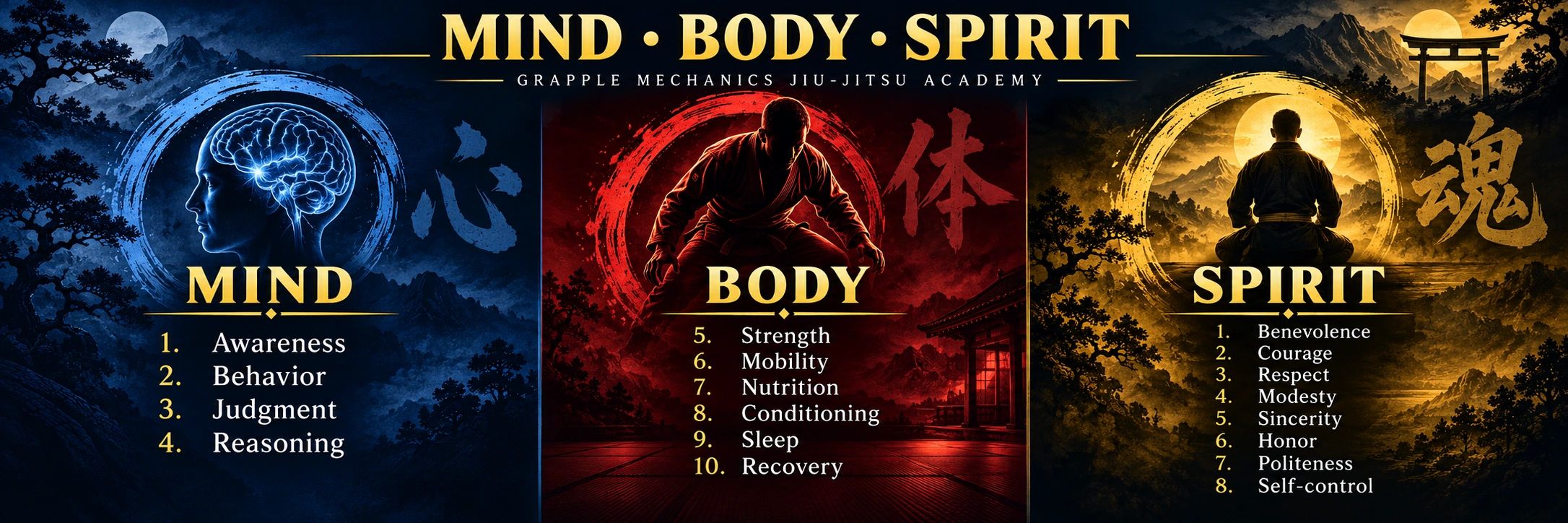
The 4-6-8 Code Philosophy
The 4-6-8 Code is a philosophical framework that Jamie Test, the founder of Grapple Mechanics®, came up with and believes every Jujutsu practitioner should aspire to live by. The four elements of the Mind develop one's ability to think clearly, make sound decisions, and control one's actions. The six elements of the Body promote physical health, fitness, well-being, and longevity. The eight virtues guide how we treat others and conduct ourselves in daily life; it helps develop our moral character -- who we become. "You reap what you sow" means that if you behave badly, bad things will come to you, and vice versa.
This code's framework extends beyond Jujutsu training and applies to education, work, family life, and personal relationships. By developing the mind, maintaining a healthy body, and practicing good moral character, we become better equipped to solve problems, fulfill our responsibilities, and contribute to society--we become better human beings.
Jiu-Jitsu is a way of life. 柔術は生き方、そのものです。
Jujutsu teaches us patience, problem-solving, and suppleness. It also develops mobility, functional strength, and physical conditioning. Students learn through repeated practice, failed attempts, corrections, and gradual improvement. A technique that initially seems impossible becomes easier as the practitioner learns proper positioning, leverage, and timing.
These lessons have practical uses outside the dojo. Patience helps us avoid making decisions out of anger. Reasoning helps us solve problems at work and at home. Physical training improves our ability to perform everyday activities. Moral character influences how we treat our families, friends, colleagues, and strangers.
With continued training, Jujutsu becomes part of our daily lives. We begin applying what we learn on the mat to the decisions we make, the responsibilities we fulfill, and the problems we encounter. Just as every technique in Jujutsu has a purpose, we must create purpose in what we do every day.
--Jamie Test